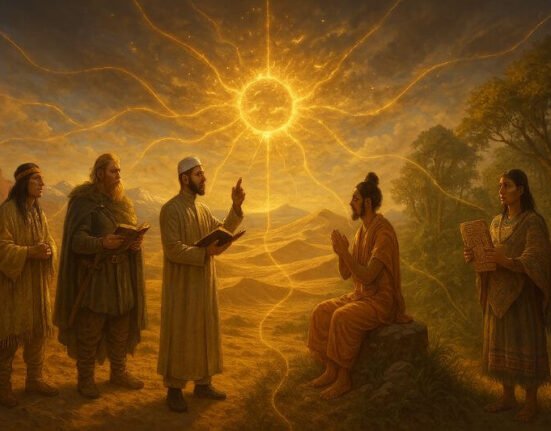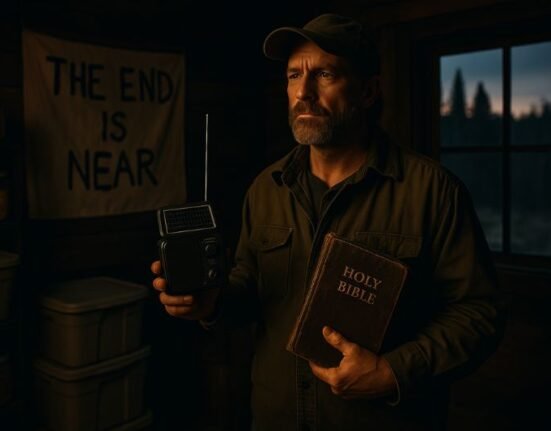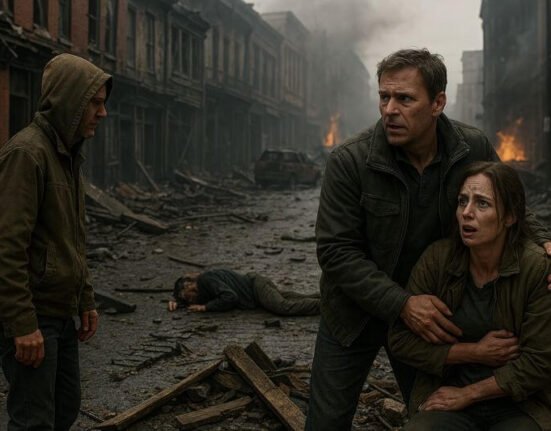




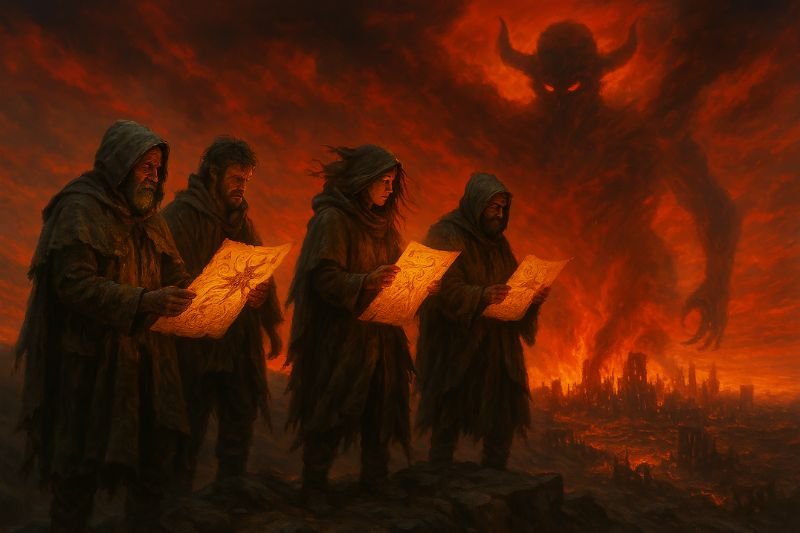
From ancient scrolls to TikTok conspiracy threads, end-time prophecies have never lost their grip on the human imagination. Whether rooted in sacred scripture or echoed in modern media, these narratives shape how we perceive chaos, catastrophe—and the fragile line between order and collapse.
This article explores five of the most influential end-time prophecies and how they continue to fuel modern thought, from survivalist strategies to global geopolitics. Understanding these eschatological visions isn’t just about looking back—it’s about staying alert to the forces that still shape our collective fear and hope.
The Book of Revelation: The Archetype of Apocalypse
No discussion of end-time prophecies can begin without the Book of Revelation—an eschatological vision so powerful that it became the blueprint for Western apocalypse narratives.
The Vision of St. John
Penned on the island of Patmos by Saint John the Divine, Revelation describes a series of cataclysms: wars, pestilences, famine, and cosmic upheavals. Its rich symbolism—the Four Horsemen, the Beast, the Mark of 666—has been interpreted both literally and metaphorically across centuries.
“And I saw a new heaven and a new earth…” — Revelation 21:1
For believers, Revelation is a warning. For scholars like Mircea Eliade, it’s a ritualized expression of sacred time: the destruction of the corrupted world to allow rebirth. Its language has echoed through Cold War fears, climate anxiety, and survivalist doctrine.
Enduring Influence
- Frequently cited by evangelical preachers and prophecy interpreters
- Fuel for rapture theology and preppers’ “tribulation-proof” living
- Referenced in survival fiction and global conspiracy theories
🔗 Read the full text of Revelation (external link)
🔗 Related on CivilFall: Survival Mindset During Global Chaos
The Mayan Calendar: A Misunderstood Reset
The year 2012 is etched in collective memory as the “Mayan end of the world.” But contrary to doomsday movies, the Maya never predicted annihilation—only the end of one calendar cycle (the 13th b’ak’tun).
Cosmology, Not Catastrophe
The Popol Vuh, a sacred Maya text, describes cyclical time and cosmic renewal. Their long count calendar reflects an advanced understanding of astronomy, not apocalyptic fatalism.
Yet in the West, the 2012 date morphed into a viral prophecy, stoking fears of planetary alignments, solar flares, or magnetic pole reversals.
Cultural Misappropriation
Anthropologist David Stuart and other experts clarified that the Maya foresaw a time of transformation, not destruction. But Hollywood and internet forums rebranded it into end-time prophecy, demonstrating how eschatological fear can be repackaged for modern consumption.
- Reignited public interest in pre-Columbian spirituality
- Spurred a wave of survivalist prepping in the early 2010s
- Reintroduced the idea of cyclical collapse to global discourse
🔗 Related on CivilFall: Cycles of Collapse in Ancient Civilizations
The Islamic Mahdi and Signs of the Hour
In Islamic eschatology, the “End of Times” is heralded by the appearance of Al-Mahdi, a messianic figure who will lead Muslims before the final judgment.
The Minor and Major Signs
The Hadith literature outlines minor signs (moral decay, false prophets) and major signs (appearance of the Dajjal, return of Isa/Jesus, sun rising from the West).
For example:
- Sunan Abu Dawood 4283: “The Mahdi will fill the earth with justice as it was filled with oppression.”
- Sahih Muslim: Lists catastrophic events preceding the end.
Contemporary Relevance
- Referenced during periods of war and societal breakdown in the Middle East
- Some political groups invoke Mahdist prophecy to justify militant actions
- A growing number of Muslim preppers align their readiness with eschatological timelines
“The hour will not be established until time passes quickly and killing increases.” — Sahih Bukhari
🔗 Related on CivilFall: Religious Prophecies and Survival Tactics
Nostradamus and the Hidden Language of Catastrophe
Michel de Nostredame—better known as Nostradamus—published his book Les Prophéties in 1555, a cryptic compilation of 942 quatrains filled with veiled visions of future disaster. Unlike religious end-time prophecies, his style is poetic and metaphorical, allowing for endless reinterpretation across centuries.
Prophecies or Psychological Projection?
One of his most cited quatrains states:
“The year 1999, seventh month, from the sky will come a great King of Terror…” — Century I, Quatrain 46
This passage has been linked to everything from alien invasions to nuclear war to the rise of global tyrants. Nostradamus never offered a clear timeline or narrative—only symbolic fragments. But that’s exactly why his work persists: it mirrors our collective anxiety and adapts with every new era of uncertainty.
Modern Uses and Misuses
- Featured in thousands of books and documentaries, often predicting disaster “this year”
- Referenced by conspiracy theorists as coded warnings
- Widely used by preppers to justify specific timelines or threats
Survivalist forums often cite Nostradamus to support the idea that world-changing events are imminent—but hidden in plain sight.
“When symbols speak louder than facts, fear becomes prophecy.” — Survivalist Commentary
🔗 Nostradamus and Apocalyptic Symbolism – University of Warwick
🔗 See also on CivilFall: Analyzing Survival Fiction: Prophets, Panic, and Preppers
Hopi Prophecies and the Path of Purification
The Hopi, one of the oldest Native American tribes, maintain a powerful set of oral end-time prophecies that have only recently entered mainstream awareness. Central to their worldview is the idea that Earth has gone through multiple world ages—each ending in catastrophe—and we are now at the brink of a Fifth World.
The Blue Star Kachina
One of the most striking Hopi predictions involves a celestial sign:
“When the Blue Star Kachina makes its appearance in the heavens, the Fifth World will emerge.” — Hopi Prophecy
Some interpret this as a comet or supernova (such as SN 1987A); others link it to satellites, strange astronomical events, or spiritual awakenings.
Unlike many Western doomsday beliefs, the Hopi view the “end” as a necessary purification, not punishment. Destruction clears the way for balance to return.
Relevance to Modern Preppers
- The Hopi path calls for reconnection with land, simplicity, and spiritual integrity
- Increasingly embraced by eco-survivalists and “back to nature” movements
- Echoed in modern fears of collapse due to environmental neglect
“If we dig precious things from the land, we will invite disaster.” — Hopi Elders’ Warning
These warnings are not about fire and brimstone—they’re about unsustainable systems. And that’s where they overlap with the survivalist mindset: collapse is inevitable when balance is broken.
Typology of End-Time Prophecies: Origins and Symbols
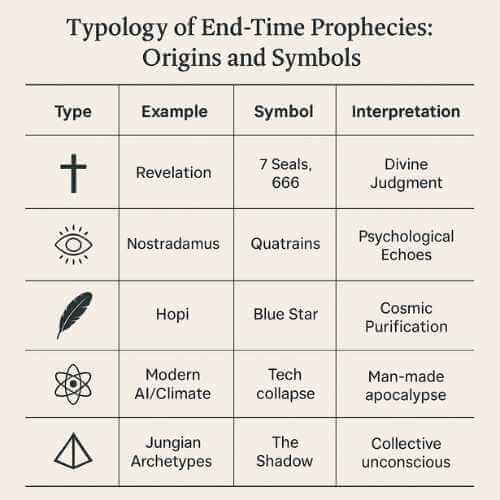
| Type | Example | Symbol | Interpretation |
|---|---|---|---|
| Religious | Revelation | 7 Seals, 666 | Divine Judgment |
| Cryptic | Nostradamus | Quatrains | Psychological Echoes |
| Indigenous | Hopi | Blue Star | Cosmic Purification |
| Scientific | Modern AI/Climate | Tech collapse | Man-made apocalypse |
| Symbolic | Jungian Archetypes | The Shadow | Collective unconscious |
End-Time Prophecies in Pop Culture: From Scripture to Screens
In the age of streaming and short attention spans, end-time prophecies have found a new medium: entertainment. From The Leftovers to The Walking Dead, apocalyptic narratives dominate our screens—not just as fiction, but as reflections of collective fear.
From Sacred to Spectacle
Prophecies that once lived in temples or oral traditions are now repackaged through thrillers, video games, and social media virality.
- Hollywood hits like 2012, The Book of Eli, or Armageddon draw directly from religious and symbolic doomsday tropes.
- YouTube prophecy channels interpret every eclipse, earthquake, or political upheaval as a sign of the end.
- TikTok trends often mimic rapture scenarios, “last day on Earth” aesthetics, or Nostradamus-inspired monologues.
As philosopher Oswald Spengler argued, civilizations in decline become obsessed with their own end. Today’s media landscape proves that point.
“The end has become entertainment. And entertainment shapes belief.” — Media theorist, J. Kaplan
🔗 Related article: Survival Fiction and the Psychology of Collapse
How Prophecies Influence Modern Survivalism
While scholars analyze end-time prophecies through theology or anthropology, survivalists approach them differently: as early warning systems. Whether literal or metaphorical, these prophecies drive action—sometimes even obsession.
Preparedness as a Response to Eschatology
For many in the prepper community, ancient texts align eerily with modern threats:
- Revelation = nuclear war or global digital control
- Islamic signs = rise of corrupt leadership and pandemics
- Hopi purification = ecological collapse
- Nostradamus = civil unrest, societal breakdown
Rather than dismiss prophecy as myth, survivalists often see it as a coded map of what’s already unfolding—filtered through ancient eyes.
The Tactical Outcome
- Bug-out plans tied to “great tribulation” timelines
- Stockpiling linked to predicted famines and market collapse
- Off-grid migration inspired by calls to “leave Babylon”
“Prophecy isn’t prediction. It’s preparation—if you know how to read the signs.” — Rural prepper interview, 2023
🔗 Related on CivilFall: Family Bug Out Strategy: How to Prepare With Kids and Elderly
🔗 Related on CivilFall: Off-Grid Solar Power Systems Explained
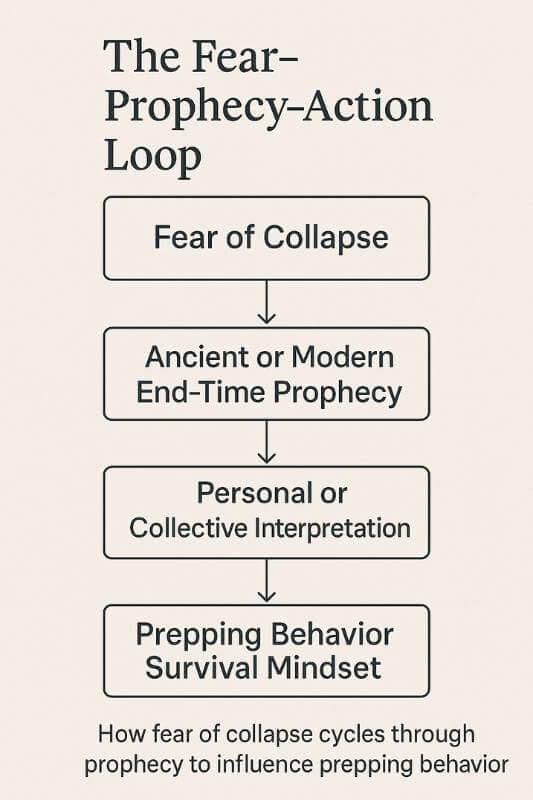
The Fear–Prophecy–Action Loop
Final Thoughts: Vigilance Beyond the Vision
End-time prophecies endure because they speak to something primal: our fear of powerlessness, our awe of the unknown, and our desire for meaning in suffering. Whether you read them as allegory or future headlines, they deserve attention—not for blind belief, but for the psychological and cultural insights they offer.
In a world of rising chaos—climate crises, geopolitical shifts, AI risks—perhaps it’s time to revisit these visions. Not to fear them, but to question what they reveal about our direction.
“Every prophecy is a mirror. The question is: what do you see in it?” — Eliade, The Sacred and the Profane
Stay informed. Stay skeptical. Stay ready.
🧠 Frequently Asked Questions (FAQ)
Q: Should I take end-time prophecies literally?
A: Not necessarily. Many end-time prophecies are filled with metaphor, allegory, and ancient cultural symbolism. Their imagery—beasts, stars falling, rivers of blood—was often used to convey spiritual truths or political commentary in highly coded language. For example, the Book of Revelation is as much a critique of Roman imperialism as it is a cosmic vision.
However, even when taken symbolically, their influence remains real. These prophecies shape worldviews, inspire behavior, and impact decisions—from political rhetoric to personal prepping. Survivalists often interpret them not as fixed predictions, but as scenario frameworks: symbolic warnings about civilizational decline, ecological collapse, or moral decay.
So whether you take them literally or not, it’s their psychological and cultural effect that matters—and that’s very real.
Q: Which prophecy is most believed today?
A: Among the most widely cited end-time prophecies today is the Book of Revelation, especially within evangelical communities, American survivalist networks, and apocalyptic pop culture. Its vivid descriptions of tribulation, rapture, and judgment have deeply influenced preparedness theology—sometimes referred to as rapture prepping.
Following closely are:
- Islamic eschatology, with its detailed signs of the Hour, including the rise of the Mahdi, the Dajjal, and the return of Isa (Jesus).
- Nostradamus’s quatrains, often resurrected in media during crises or significant world events.
- Mayan calendar misinterpretations, which, though largely debunked in 2012, still shape cyclical end-times thinking.
In short, no single prophecy dominates universally. But Revelation remains the benchmark—both feared and decoded in modern end-time belief systems.
Q: Are there new prophecies being made today?
A: Absolutely. In the digital age, new end-time prophecies emerge constantly—often not from ancient texts, but from online influencers, spiritual movements, and conspiracy theorists. These “modern prophets” use current events—pandemics, wars, eclipses, climate disasters—as signs of impending doom.
Examples include:
- Claims about AI becoming the Antichrist
- Warnings that global elites plan a “Great Reset” apocalypse
- Viral TikTok and YouTube prophecies forecasting rapture dates or alien interventions
While many of these are unfounded or speculative, they spark real-world reactions. Some followers change their financial habits, relocate to remote areas, or create underground prepping communities.
The takeaway? Prophecy has evolved—but its impact on behavior remains timeless.
Q: How do I prepare if I don’t believe in prophecies?
A: You don’t need to believe in end-time prophecies to recognize that civilization is vulnerable. Think of prophecy not as truth, but as narrative framing—a way to give shape to real concerns: food insecurity, system collapse, authoritarian control, ecological tipping points.
Use prophecy as a lens, not a roadmap. It can help you:
- Identify key fears driving public behavior
- Map potential crisis scenarios (like economic collapse or grid failure)
- Understand how others around you might react in a panic
From there, your survival strategy should be grounded in fact:
- Build redundancy (power, food, water)
- Learn real skills (first aid, navigation, gardening)
- Create community bonds
In other words: prepare rationally, observe symbolically.